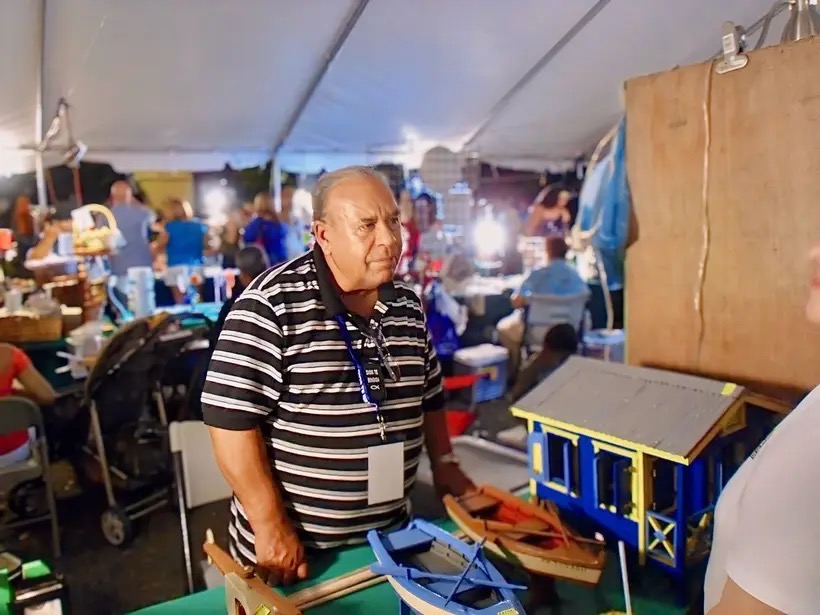
Nestled along the beautiful southern coast of Puerto Rico, the seaside fishing town of Salinas is renowned not only for its stunning coasts but also for its rich maritime culture, deeply rooted in tradition. This culture originates from the region’s indigenous people, who referred to this area as Abeyno. Among these traditions, the art of building and fishing with yolas stands as a testament to skills passed down through generations within families, including within my own.
Yolas are flat-bottomed boats traditionally used by coastal communities and have long been essential for fishing and transportation in the region. The knowledge of how to construct yolas is often an inherited skill, learned from family or friends and refined over time through hands-on experience. In my family, this practice has become a cherished part of our identity, deeply connected to the rhythms of the sea and the ecosystem that sustains us.
During my visit to Salinas, I was fortunate to learn from my uncle, Diego Correa, affectionately known as Tio Meli. He is a skilled craftsman and an expert on local marine ecosystems. My uncle taught me about the materials used in building yolas, particularly the significance of the Tabonuco tree, scientifically known as Dacryodes excelsa. The trunk of the Tabonuco tree is utilized to construct small dugout canoes. Its slight resistance to decay means that heartier, more durable trees are often also used, with Tabonuco resin applied as a sealant to help preserve the integrity of the vessels against harsh marine conditions.
Tabonuco trees are found in many mountainous regions of Puerto Rico and can also be found in the Lesser Antilles of the Caribbean region. In Puerto Rico, these trees can be found in the Luquillo Mountains, the Toro Negro State Forest, the Cordillera Central, and the Yunque Rainforest. It’s interesting to note that large stands of Tabonuco trees are often located near significant indigenous population centers, such as the Barrio named Tabonuco in the municipality of Sabana Grande, Puerto Rico, an area that falls within the historic domain of Agueybana II.
Building a yola involves more than just crafting a boat; it requires a deep understanding of the sea, the tides, and the local fishing grounds. While techniques of yola construction have evolved over time, they still reflect the Indigenous roots that underpin this practice. My uncle would fondly speak of the traditional methods passed down from our ancestors, showcasing how these skills are interwoven with our community’s identity.
According to Isabella Schaedle, a Boricua and a Master of Advanced Studies (2022-2023) in Marine Biodiversity and Conservation at the Scripps Institute of Oceanography, UC San Diego, today’s yolas are built using a combination of plywood and planks resembling modern outboard skiffs. However, both the form and materials of contemporary pirogues and yolas clearly reflect their Indigenous origins.
Douglas C. Pyle, the author of “Clean, Sweet Wind: Sailing with the Last Boatmakers of the Caribbean,” notes that the pirogues of Trinidad, like dugout canoes and their derivatives such as yolas, have waterlines that exhibit much greater hollow than found in any other small craft in the Caribbean. Most of these boats rely on the Gommier tree, also known as the Tabonuco tree. The use of the tree’s shell as a keel indicates the dugout canoe origins of these vessels. One of Pyle’s informants suggested that the pirogue “was of Amerindian origin, and that raising strakes or planks on the sides had been a development linked to the diminishing availability of large tree trunks for dugout canoes.”
As I reflect on my family’s legacy of yolas, I am reminded of my uncle Diego, whose teachings are deeply imprinted in my heart. The traditions rooted in Salinas continue to thrive as new generations learn the art of yola construction and fishing. They often start by crafting small-scale models, a step advised by master craftsmen who emphasize its importance. I have carried this approach forward in my own dugout canoe-building endeavors. This method not only teaches basic shapes and lines but also essential skills such as tool control and wood selection. Essentially, each yola built represents a connection between the past and the future, serving as a vessel that carries not only fishermen but also the stories, values, and traditions of our community.
In Salinas, the yola is not merely a mode of transportation; it is a symbol of resilience and a connection to the ocean. Families like mine rely on these vessels for sustenance, spending countless hours navigating the waters to catch fish that nourish our families and feed our community. Listening to my uncle share tales of fishing adventures and the storms braved on yolas has instilled in me a profound respect for the ocean and the importance of preserving our maritime heritage.
As I stand by the shore, watching the sun dip below the horizon, I know that the lessons learned in Salinas will guide me on my dugout canoe journey, ensuring that the spirit of Indigenous watercraft—and my uncle Diego’s legacy—lives on.

 Taíno Canoe Project